
LAB-BP-02 / Bookmaking and printing
Six-panel fallback and modern ground comparison
What does alternating folding change, and how does a modern white coating affect a sample surface?
Modern classroom adaptation. A six-panel modern accordion and acrylic-primer coupons are adaptations. Modern acrylic adhesion, flexibility, absorption, and aging do not test ancient gypsum or carbonate grounds. Purchased amate must be an expendable teaching sample, not finished artwork. Covers are optional modern design choices.
History and chapter connections
A Mixtec deerskin screenfold and a Maya bark-paper manuscript share a folding format while retaining different materials and histories. Compare the model’s support and modern coating separately.
Read the Tonindeye (Nuttall) dossier ↗
- Chapter 3 · A surface is manufactured
- Chapter 4 · Color is work
- Chapter 5 · Folds, surfaces, and reading order
Chapter references follow the twelve chapters of Books Were Already Here. The full manuscript is separate from these lab pages.
Read the historical background and its evidence limits
A sheet of paper is a record of decisions: which plant to use, who can obtain it, how to prepare it, how to join fibers, what surface a painter needs, and how to sustain the people and landscapes involved. Teach three related but distinct histories:
- Surviving ancient and early manuscripts: evidence belongs to particular objects and cultures.
- Living Indigenous practices: contemporary makers explain their own work, innovations, and circumstances.
- A classroom experiment: a deliberately modified procedure tests a material question. Success does not prove that an ancient workshop used that procedure.
A useful label throughout the chapter is observed object / documented practice / proposed classroom model. These are evidence categories, not rankings of cultural value. An archaeological object can disclose its materials but not every movement of its maker. A living practitioner can explain a present method without being required to represent every past society.
Book-specific anchors
- INAH identifies the support of the Códice Maya de México as inner bark from a fig in the genus Ficus. Its public materiality account distinguishes inner-bark sheets from sheets formed from beaten fibers. It identifies a thin gypsum preparation on both sides, although only one was illustrated. The reported radiocarbon interval refers to the tree material, not an independently precise date of painting. [S1]
- SLUB, custodian of the Dresden Maya Codex, describes bark-fiber support with a calcium-carbonate ground. Its account records a 3.56 m screenfold and describes subsequent divisions, repairs, wartime wetting, and losses where the white layer adhered to glass. The surviving object is therefore also a history of collection and intervention. [S2]
- The British Museum describes the Tonindeye (Nuttall) Codex, a Mixtec manuscript, as a painted deerskin screenfold. This is a necessary counterexample: an accordion-shaped Indigenous book is not automatically bark paper, and a Mixtec book should not be labeled Maya. [S3]
Editorial consequence: do not print one universal “Maya/Mixtec amate recipe.” Do not equate calcium carbonate, calcium hydroxide, and gypsum. Do not say that every white ground contains an identified glue, that every book had identical covers, or that a classroom reconstruction demonstrates a complete ancient production sequence. Use “ground” or “preparation layer” unless a source and object justify a more specific term.
Named practitioner voices
Julio Laja Chichicaxtle and Cirila Trejo Gonzales. A 2021 Cultural Survival profile identifies Laja as Otomí and uses the spelling Ñühü for the language. It presents papermaking as intergenerational family knowledge and Trejo as a business partner and designer. Their decision to limit expansion makes an important classroom point: makers decide what a sustainable livelihood means. The profile reports Laja's processing account and local tree name popova, but does not provide a botanical voucher identification. Do not silently turn that name into a particular Latin species. [S4]
Gaspar Santos and René Trejo Hernández. CECCAM's Territorios del agua publishes extended interviews with these San Pablito practitioners. Santos discusses bark supply, washing, water governance, changes in cooking agents, and learning through work. Trejo describes planting his own jonote supply. These are named accounts of skilled work and community decisions, rather than anonymous illustrations of “a vanished craft.” The interviews also disagree with blanket claims that stripping bark never harms a tree: Santos describes jonote dying after stripping and discusses regrowth after cutting. Treat species, harvesting method, and local conditions as essential questions. [S5]
Jorge Luis Santos. Museo Amparo's published 2024 workshop identifies him as an artisan from San Pablito Pahuatlán and schedules the full process over six sessions, 24 hours, for participants older than 16. This is evidence of a contemporary practitioner teaching an extensive craft. It is not evidence that the same hot/chemical sequence is suitable for an ordinary school classroom. [S6]
Naming practice: use the community or speaker's preferred spelling when known; preserve the spelling used in a cited first-person account. “Otomí” is a widely used umbrella name, not a reason to treat all Otomí communities as one workshop. Do not imply that the several spellings Ñühü, Hñahñú, and Hñähñu are interchangeable in every local language context. Local names and pronunciations require appropriate verification. No community consultation or endorsement is claimed.
A documented process, not a timeless formula
Carol Tyroler's 1994 first-person account of work with San Pablito papermakers describes selecting and sorting inner bark; soaking and cooking it; thorough rinsing; arranging strips across a wetted wooden board; beating them with a stone; refining edges; drying on the board; and finishing sheets. The amount of fiber affects thickness, the board affects surface quality, and readiness depends on experienced judgment rather than a timer alone. Tyroler describes rough and smooth working faces on the beater and patching as part of skilled finishing. Use this account as a dated observation of specific contemporary practice. Its broader claims about ancestry, exclusivity, and harmless harvesting should not be adopted uncritically. [S7]
A 2024 ethnobotanical study by Rebolledo-Morales and López Binnquist reports thirteen plant species in the documented material repertoire, with three no longer used, and identifies Trema micrantha as especially important since the 1980s. Its abstract explicitly emphasizes changing fibers, manufacturing techniques, and the creativity of younger Hñahñú makers. That evidence contradicts a textbook claim that the process “has never changed.” Only the abstract and indexed portions were retrievable here; the full article requires a subsequent editorial read before using its finer technical claims. [S8]
UNAM's current exhibition text identifies jonote colorado (Trema micrantha) and jonote de mora (Morus celtidifolia) among present-day materials. A common name such as “mulberry” is not sufficient material identification. Japanese kōzo (Broussonetia papyrifera) is a different plant from Morus celtidifolia and is not a neutral substitute in a historical claim. [S9]
Cultural boundaries for the classroom
- Name makers and communities as contemporary intellectual and artistic contributors.
- Use an artisan's publicly offered instructional work within its stated terms. Public display of a ritual object is not an invitation to reenact a healing ceremony.
- Do not assign students to impersonate a healer or fabricate a supposedly authentic sacred cutout. Use their own non-sacred geometric patterns, school-history narrative, or material observations.
- Pay a guest practitioner for teaching and consultation; agree on recording, image use, attribution, and compensation. Do not assume that buying a sheet buys rights to reproduce its design.
- Distinguish the maker of a support from its painter. The Mexican cultural-information service describes modern exchange between San Pablito papermakers and Nahua painters in Guerrero, alongside new forms developed in San Pablito itself. That is collaboration among distinct communities, not a generic “Aztec art” style. [S10]
Extended historical background remains available on this lab’s web page.
Time and class planning
- Active estimate
- 100 minutes
- Sessions
- 2
- Adult preparation
- Not specified
Overnight or longer, governed by the actual primer drying/cure and adhesive instructions. Teacher pilot at least two days before class.
Touch-dry is not automatically ready for a fair test.
Scale consumables from 24 students, round upward; recalculate shared-equipment throughput separately. Stock ink is an allowance, not required consumption. All timings are planning estimates; unknown quantities and times remain unspecified.
Materials
Baseline: 24 students in 24 groups of 1. Read teacher preparation and material conditions before arranging the activity.
Flexible contemporary teaching amate or labeled drawing-paper strips
24 strips · class
Each 10 × 60 cm; drawing-paper substitute 120–160 gsm.
Cardstock cover boards
48 boards · class
Each 11 × 11 cm.
Same-support coupons
72 coupons · class
Three 5 × 5 cm coupons per student: A bare, B coated, C repeat reserve.
Premixed school-approved water-based white acrylic primer
120 mL · class / 5 mL maximum · student
Up to 5 mL per student, plus small teacher-pilot allowance. Follow exact product directions.
120 mL is allocation before pilot allowance; 250 mL bottle is only an unverified coverage possibility, not a purchase instruction.
Small brushes
24 brushes · class
Rulers, pencils, rounded plastic folders or fingers, school-approved glue sticks
Not specified sets · class
Share measurement tools; actual adhesive quantity depends on selected product.
Blunt scissors
Not specified pairs · class
Only if cutting is needed.
Protected trays and labeled drying places
24 sets · class
Washable black water-based markers
24 markers · class
Colored pencils
24 pencils · class
Water-based school paint
Not specified allocation · class
No dry pigments; product amount unspecified.
Optional bend-test duplicate coupons
48 coupons · class
Two additional 5 × 5 cm expendable coupons per student, one bare and one coated. Baseline 72 coupons; 120 total if bend comparison is selected.
Broad rounded bending supports
Not specified supports · class
For one gentle bend on duplicate coupons only; teacher selects suitable approved shared supports.
Unspecified exact quantity; choose an adequate approved shared allocation.
Safety and stop conditions
Read these controls with the teacher before handling materials. Chemical etching is historical context only; the practical intaglio activity uses drypoint without mordants.
Controls
Use expendable teaching samples and school-approved premixed water-based primer, markers and glue; obey actual labels/ventilation and school requirements.
Keep coatings away from folds unless a separately piloted cracking experiment is intended.
Use broad gentle bending on duplicate coupons only; protect drying area; wash hands and manage waste.
Stop when
Cracking or resistant amate folds: use drawing paper and retain amate for inspection.
Unknown coating composition, unacceptable sensitivity, or product handling limits: use known purchased coated/uncoated samples or a no-primer version.
Tacky coating or insufficient cure: postpone comparison.
Trained adult only
Teacher cuts/prepares stock as needed, selects actual materials, pilots process, verifies cure and approves repeats.
Any knife or guillotine cutting; confirm readiness of the actual primer before testing.
Excluded activities
Historical-object tests or alterations to a finished artwork.
Dry powders, student lime/gypsum preparation, chemical cooking, and inferred ancient aging claims.
Ordered student procedure
Identify the material, five minutes. Record the maker or supplier, support type, and purpose of the model. If the plant identity is unknown, retain that uncertainty.
Test and measure, five minutes. Test a scrap for folding. Mark the strip at 10, 20, 30, 40, and 50 cm from one end. If the purchased sheet cracks or resists the fold, use drawing paper for construction and retain the original material as an inspection sample.
Fold, ten minutes. Alternate the direction at each mark to make six connected 10 × 10 cm panels. Align the edges before pressing each fold. Open the strip on the table and check the sequence.
Plan the contents, ten minutes. Use an ordinary school event or a fictional garden project. Allocate the panels to setting, participants, preparation, action, consequence, and sources or credits. Create your own modern marks with a written key. Keep the information clear of folds.
Prepare coupons, ten minutes. Label the backs A, B, and C. Leave A bare. Apply one thin, even brush layer of the supplied primer to B, recording the amount actually used. Reserve C for an approved repeat. Keep coating away from the book folds.
Store and clean, ten minutes. Leave the coupons flat in the labeled place for the full product-specified interval. Store the unpainted strip safely. Return unused material as directed, wipe the work area, and follow the teacher's waste and rinse-water instructions.
Check readiness, five minutes. Begin the comparison only after the teacher confirms the coated surface is ready. If it is still tacky, continue the book's pencil layout and delay testing.
Compare lines, ten minutes. Use the same marker to draw equal-length lines on A and B with comparable light pressure. Repeat with the same colored pencil. Record line spread, visibility, drag, roughness, and show-through. Do not assume that the coating improves every kind of mark.
Compare a bend if assigned, five minutes. On expendable duplicates only, make one gentle bend over a broad rounded support. Record stiffness or flaking. Do not repeatedly crease the artwork or treat this short observation as a test of centuries of aging.
Complete the sequence, fifteen minutes. Add the planned modern content. If using covers, identify the two exposed outer end faces of the closed model and attach one cardstock piece to each with glue stick, keeping adhesive out of folds. The covers are a classroom design choice.
Write the colophon and conclusion, ten minutes. A colophon is a production note. Name your materials, date, sources, credits, substitutions, and the purpose of the model. Explain which support you chose for the marks and what observation informed that choice.
Clean and store, five minutes. Store the model supported and dry. Keep the coupons with the observation record so the comparison remains available.
Process diagrams

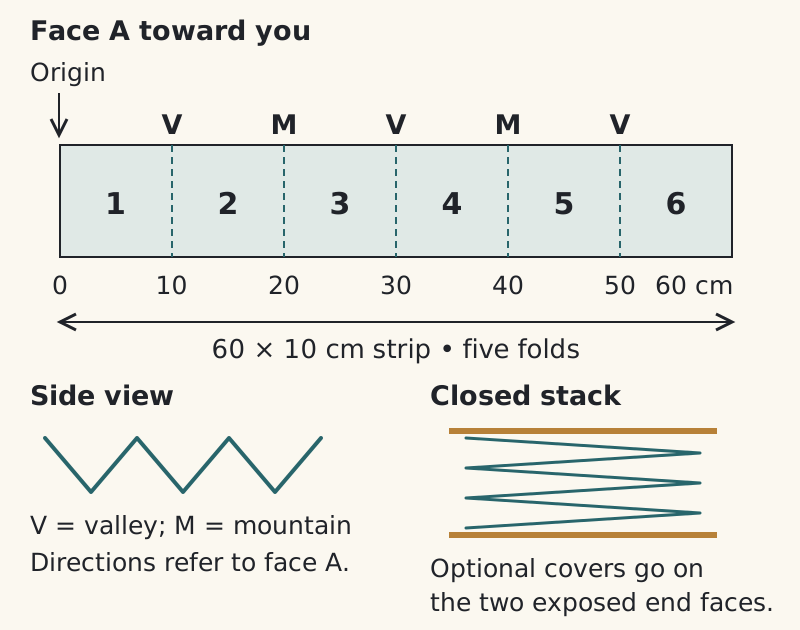
Text equivalent
A 60 by 10 centimeter strip has six panels and folds at 10, 20, 30, 40, and 50 centimeters. From face A, the folds alternate valley, mountain, valley, mountain, valley. A side view shows the pleats; a closed stack shows optional covers on its two exposed end faces.

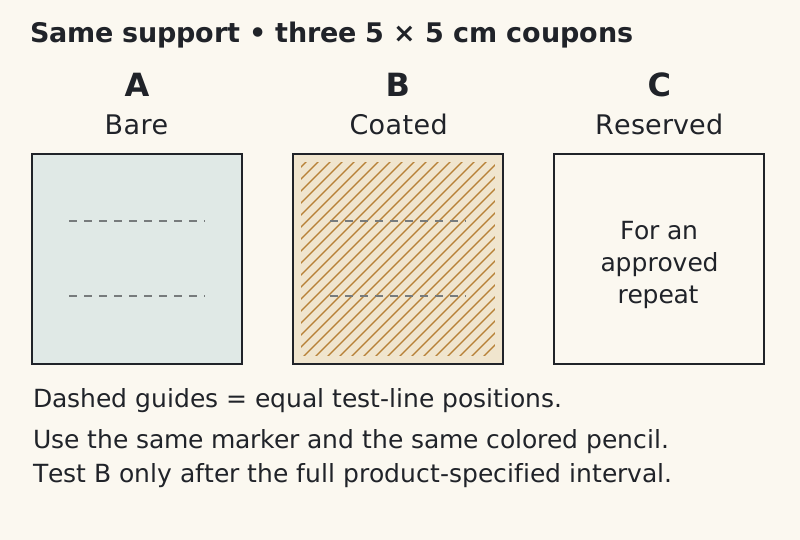
Text equivalent
Three same-support square coupons are labeled A bare, B coated, and C reserved. A and B have equal-length dashed guide positions for marker and colored-pencil tests; C is kept for an approved repeat. No test outcome is drawn.
Accessible alternatives
Use pre-cut or pre-folded drawing paper, partner-assisted construction, source analysis, or audio documentation.
Run coupon comparison separately from the structure build. Use known purchased coated and uncoated teaching samples without primer; if composition is unknown, describe visible differences only.
Offer no-contact material observation and non-percussion access; tapping is not needed.
Troubleshooting
- Amate cracks or resists a tight crease
- Check: Test a scrap; inspect flexibility and support thickness.
Action: Use drawing paper for the model and keep amate as an inspected sample. - Coating is touch-dry but not fully cured
- Check: Read the exact product drying/cure instructions and test the separate teacher coupon.
Action: Extend drying; do not compare prematurely. - Coating stiffens, flakes, changes drag, or worsens marker behavior
- Check: Compare equal-length marks, same tools/pressure, actual coating volume and bare control.
Action: Record the result; no universal improvement is assumed. Bend only expendable duplicates.
Record and assess
Submit the model, coupons, and a 150-word explanation of the surface comparison. Use the same 20-point criteria as LAB-BP-01, replacing fiber quantities with support dimensions, coating amount, and drying time. Explain why your observation cannot rank the historical performance of gypsum and calcium carbonate.
Submit the samples or their documented remains, a labeled process drawing, and a 150–200-word argument. State one observation, one interpretation supported by it, one limitation, and one justified improvement. Include this caption with the actual details filled in: “Modern classroom model using [material], made by [makers and date]. This investigation examines [question], draws on [named source], and substitutes [materials or operations]. It does not establish a complete ancient recipe.”
The 20-point assessment gives four points each for historical specificity, source use and uncertainty, honest quantities and timing, material interpretation, and safe credited practice. Smoothness and resemblance to an Indigenous work are not separate measures of historical understanding.
Rubric · 20 points
- Cultural and historical specificity · 4 points
- Evidence reasoning · 4 points
- Practical documentation · 4 points
- Material interpretation · 4 points
- Responsible practice · 4 points
Assess evidence, documentation, safety, historical specificity, and acknowledged limits; do not grade cultural imitation, beauty, speed, or physical strength as historical understanding.
Predictions to test
These are expected possibilities, never reported trial results. Record what actually happens, including failure.
Folding may produce a six-panel compact model; thick teaching amate may resist or crack and require the drawing-paper fallback.
Coating may change line spread, visibility, drag, roughness, show-through, stiffness, or flaking; no improvement or historical equivalence is guaranteed.
Sources and access limits
Source access labels below are retained from the commissioned research. Partial, indexed, abstract and catalogue access do not imply a full-text reading. No new source reading or classroom trial is claimed by this website addition.
The printed reference list retains access labels and linked titles. Full source access notes remain on this lab’s web page.
Instituto Nacional de Antropología e Historia (INAH). _Códice Maya de México_, materiality/conservation exhibition.
Instituto Nacional de Antropología e Historia (INAH). Códice Maya de México, materiality/conservation exhibition. https://codicemayademexico.inah.gob.mx/ . Relevant text retrieved through indexed content; the live page's text extraction omitted some interactive panels. Use the headings on support and imprimatura. Primary custodial/interpretive institutional source. Do not convert the site's public summary into a fully specified ancient recipe.
Sächsische Landesbibliothek—Staats- und Universitätsbibliothek Dresden (SLUB). “Material / Conservation / Presentation.”
Sächsische Landesbibliothek—Staats- und Universitätsbibliothek Dresden (SLUB). “Material / Conservation / Presentation.” https://www.slub-dresden.de/en/explore/manuscripts/the-dresden-maya-codex/material-conservation-presentation . Full relevant page text retrieved. Custodial source with conservation references linked at the end; especially valuable for showing how later interventions affect current appearance.
British Museum. “The Tonindeye (Nuttall) Codex,” Am1902,0308.1.
British Museum. “The Tonindeye (Nuttall) Codex,” Am1902,0308.1. https://www.britishmuseum.org/collection/object/E_Am1902-0308-1 . Substantive indexed collection record retrieved, including materials and description; live page open returned 403. Collection evidence supplies the deliberate material/cultural counterexample. The record also names Indigenous scholarly collaborators.
- BP-S3 · Source link ↗
Link check, 18 October 2026: HTTP 403. Original citation retained; source access was not re-established.
- BP-S3 · Source link ↗
Danae Laura. “Art and Healing by Way of the Generous Tree: Julio Laja Chichicaxtle.” _Cultural Survival Quarterly_, 6 December 2021.
Danae Laura. “Art and Healing by Way of the Generous Tree: Julio Laja Chichicaxtle.” Cultural Survival Quarterly, 6 December 2021. https://www.culturalsurvival.org/publications/cultural-survival-quarterly/art-and-healing-way-generous-tree-julio-laja-chichicaxtle . Full text retrieved. Named practitioner profile in an Indigenous-rights organization; distinguish testimony and editorial description. English version checked because the Spanish translation's rendering of “lime” as “limón” could mislead a recipe reader.
Carol Tyroler. “Amate Papermaking in San Pablito.” _Hand Papermaking_ 9(2), Winter 1994, starting p. 21.
Carol Tyroler. “Amate Papermaking in San Pablito.” Hand Papermaking 9(2), Winter 1994, starting p. 21. https://www.handpapermaking.org/magazine-articles/amate-papermaking-in-san-pablito . Full article text retrieved. First-person practitioner/anthropological observation. Some terminology and general historical assertions are dated and unsuitable for uncritical reuse; the process sequence is used narrowly.
Instituto de Biología, UNAM. _Metamorfosis: del papel a la vida_, “Sobre el papel: Amate,” exhibition by Cekouat León, September 2026–February 2027.
Instituto de Biología, UNAM. Metamorfosis: del papel a la vida, “Sobre el papel: Amate,” exhibition by Cekouat León, September 2026–February 2027. https://www.ib.unam.mx/ib/pabio/exposiciones/origami/ . Full relevant text retrieved. Current institutional exhibition text by an artist/biologist; its dated references offer follow-on reading. Use the relevant amate section, not the page as blanket authority for every botanical name.
Robert C. Williams Museum of Papermaking, Georgia Institute of Technology. “Virtual Bark Paper Demonstration Lecture,” Lisa Miles, 8 March 2022.
Robert C. Williams Museum of Papermaking, Georgia Institute of Technology. “Virtual Bark Paper Demonstration Lecture,” Lisa Miles, 8 March 2022. https://paper.gatech.edu/virtual-bark-paper-demonstration-lecture . Full relevant text retrieved. Explicitly frames modern materials as approximation. The event was aimed at adults; its existence does not validate this school lab.
Centro de Estudios para el Cambio en el Campo Mexicano (CECCAM). _Territorios del agua_, “San Pablito: El papel amate.”
Centro de Estudios para el Cambio en el Campo Mexicano (CECCAM). Territorios del agua, “San Pablito: El papel amate.” https://www.ceccam.org/territorios-agua/contenido/terrunos/san-pablito/ . Full text retrieved. Extended first-person interviews; most useful here for water, expertise, supply, and cultivation, rather than copying ritual details or household chemical instructions. The page does not support universal claims about every workshop.
Museo Amparo. “Papel amate,” workshop taught by Jorge Luis Santos, 3 August–7 September 2024.
Museo Amparo. “Papel amate,” workshop taught by Jorge Luis Santos, 3 August–7 September 2024. https://museoamparo.com/actividades/detalle/3227/papel-amate . Full relevant listing retrieved. A past program and practitioner-teaching reference, not a verified current opportunity or school safety approval.
Adolfo de Jesús Rebolledo-Morales and Citlalli López Binnquist. “Fibras y diseños utilizados en la elaboración de papel amate en San Pablito, Pahuatlán, Puebla, México.” _Polibotánica_ 58 (July 2024): 237–249. DOI 10.18387/polibotanica.58.17.
Adolfo de Jesús Rebolledo-Morales and Citlalli López Binnquist. “Fibras y diseños utilizados en la elaboración de papel amate en San Pablito, Pahuatlán, Puebla, México.” Polibotánica 58 (July 2024): 237–249. DOI 10.18387/polibotanica.58.17. https://www.scielo.org.mx/scielo.php?pid=S1405-27682024000200237&script=sci_arttext . Publisher PDF: https://www.polibotanica.mx/index.php/polibotanica/article/download/1096/1360 . Abstract and substantive indexed excerpts checked; full HTML/PDF fetches failed. Only claims actually present in those excerpts are used. Obtain and read the full paper before citing its tables or copying species lists.
Secretaría de Cultura, Sistema de Información Cultural. “Figuras de papel amate,” Pahuatlán, Puebla, last modified 12 January 2010.
Secretaría de Cultura, Sistema de Información Cultural. “Figuras de papel amate,” Pahuatlán, Puebla, last modified 12 January 2010. https://sic.gob.mx/ficha.php?table=artepmex&table_id=36 . Full relevant text retrieved. Dated institutional craft/environment description. Its chemical process is descriptive and must not be copied as a classroom procedure.
Paper Connection. “White Kozo Dried Pulp Squares—11g.”
Paper Connection. “White Kozo Dried Pulp Squares—11g.” https://shop.paperconnection.com/products/hydrated-kozo-fiber . Full listing retrieved. Commercial source used only to verify material form and reveal a procurement mismatch; not a recommendation to buy or evidence of historical practice. Listing showed sold out when checked.
CDC/NIOSH. _Pocket Guide to Chemical Hazards_: “Calcium hydroxide.”
CDC/NIOSH. Pocket Guide to Chemical Hazards: “Calcium hydroxide.” https://www.cdc.gov/niosh/npg/npgd0092.html . Substantive hazard content retrieved. Establishes the hazard boundary; do not confuse this compound with calcium carbonate.
CDC/NIOSH. _Pocket Guide to Chemical Hazards_: “Sodium hydroxide.”
CDC/NIOSH. Pocket Guide to Chemical Hazards: “Sodium hydroxide.” https://www.cdc.gov/niosh/npg/npgd0565.html . Full hazard text retrieved. Supports excluding caustic cooking from student activity; a school still needs its own approved risk assessment.
Carriage House Paper: Thai kozo, cooked and bleached (candidate only)
The manuscript source-verification update dated 18 October 2026 reports that the product page describes cooked, cleaned, bleached damp Thai kozo, a 1.5 lb wet bag corresponding to 0.5 lb dry, and soaking followed by hand beating. The page was not independently reopened during this data transformation. This establishes a prepared-fiber candidate only. Long-strip geometry, final rinsing/residual chemistry, school handling suitability, and overlap-lattice suitability remain unverified. No stable price, purchase recommendation, historical authenticity, or successful pilot is claimed.
- BP-PROC-01 · Source link ↗
Link check, 18 October 2026: HTTP 403. Original citation retained; source access was not re-established.
- BP-PROC-01 · Source link ↗