
LAB-SF-01 / Bookmaking and printing
Eight-panel research screenfold
What changes when information can be seen as both an extended strip and a compact book?
Modern classroom adaptation. Getty provides a modern accordion-teaching precedent. Dimensions, join, content plan, access tests and assessment are newly specified classroom choices. The model is not an ancient manufacture demonstration or replica; invented icons are not Indigenous glyphs.
History and chapter connections
The Dresden Maya Codex provides a historical point of comparison for the screenfold’s extended field. The dimensions, seam and covers below are modern classroom choices.
Read the Dresden Maya Codex dossier ↗
- Chapter 5 · Folds, surfaces, and reading order
Chapter references follow the twelve chapters of Books Were Already Here. The full manuscript is separate from these lab pages.
Read the historical background and its evidence limits
1.1 A fold is a structure, not a culture
A screenfold has a continuous support divided by alternating folds. It can be inspected as a compact stack, a short opening, or an extended sequence. The Getty's terminology describes historical examples assembled from hide or paper with a prepared painting surface. The category does not make all examples identical in support, paint, cultural affiliation, contents, or reading order. “Codex” is broader than “accordion book”: named Mesoamerican codices also include sheets, maps, rolls, and European-style volumes. [S01, S02]
A useful original diagram distinguishes three questions:
- Physical sequence: Which surface lies beside which when opened?
- Reading sequence: In what order does a particular reader follow signs, scenes, dates, or bands?
- Historical sequence: In what order did the represented events happen?
These need not coincide. Modern page numbers belong to another layer: cataloguing or publication. Do not mistake a scan viewer's left-to-right button for evidence of an original reading route.
1.2 Maya case: a book for working with time
Documented object: Códice Maya de México, approximately 1100, is a surviving pre-European Maya manuscript painted with mineral and organic colorants on prepared bark paper. The Getty–INAH exhibition identifies it as a sacred Venus book and one of four surviving pre-European Maya manuscripts. The surviving count concerns books, not every trace of Maya writing, and it must not be used to suggest Maya peoples disappeared. [S03]
Reading: The exhibition's reading guide reconstructs a twenty-page original sequence, of which ten pages survive. It describes proceeding left to right, row by row across the book. A date column, a deity, and a count connecting the next Venus phase work together. This is evidence about this manuscript. It is not a rule that all Maya inscriptions or codex passages are read the same way. [S04]
Writing: Maya writing includes signs for words and for syllables. A page is not simply a collection of pictures whose meanings can be guessed from resemblance. The British Museum's introductory account is useful for explaining this distinction; it does not supply a complete key for translating a chosen codex page. [S05]
Uses and users: The Dresden manuscript supplies a second case: almanacs and astronomical tables integrate calculation with ritual and divination. Its Venus section is located on manuscript pages 24 and 46–50; eclipse tables are on pages 51–58. These are not modern astronomy worksheets with religious decoration added afterward. The relationship among counting, divine agency, and decisions is part of the historical evidence. [S06]
People behind the surface: A seventh–eighth-century Maya vessel in the Metropolitan Museum uses a painting style compared with surviving codices. It is evidence of visual relationships between media, not a paper book and not proof that its painter also manufactured paper. A separate Met study discusses portrayals of scribes painting or consulting books. Images of work, a surviving book, and chemical identification answer different questions. [S07, S08]
Teach with care: Say “Maya” for the peoples and culture; name a particular Mayan language when discussing language evidence. Do not invent a single timeless “Maya language.” Do not ask pupils to translate their names by swapping English alphabet letters for attractive glyphs.
1.3 Ñuu Savi/Mixtec case: dynastic knowledge in a long painted surface
Documented object: The British Museum catalogues the Tonindeye (Nuttall) Codex as a deer-skin screenfold of 47 leaves, approximately 19 by 23.5 cm per page, made in the Mixteca region during 1200–1521. Its two sides present distinct narratives: histories of important centres and an account of the genealogy, marriages, politics, and military actions of Eight Deer Jaguar Claw. The physical object's production date must be distinguished from the dates of people and events represented. [S09]
Interpretation and route: John Pohl describes red guide lines assisting a meandering or boustrophedon route, difficult connections between narrative sections, and different emphases among related manuscripts. [S10] An analytical inference for students to test is that a genealogy selects relationships relevant to authority rather than recording everything that happened.
Reading and voice: John Monaghan's 1990 article argues from the premise that codices functioned as scripts for performance, relating arrangement to verbal artistry. The accessible abstract supports describing this as a scholarly argument, not claiming that we possess a recording of a specific ancient performance. A classroom oral presentation can explore the problem but cannot recreate a lost performance. [S11]
Living scholarship: Ñuu Savi scholars and cultural practitioners Omar Aguilar Sánchez and Izaira López Sánchez have connected codex research with community educational projects in Oaxaca, Guerrero, and Puebla promoting Tu’un Savi. Contemporary work belongs inside the chapter, not in a token final sentence after an account of European collections. Spellings and self-designations vary with language and community; retain a named source's form rather than forcing all forms into one spelling. [S12]
Teach with care: Introduce “Ñuu Savi/Mixtec” for orientation, then use the community or scholar's preferred term in the relevant context. Preserve the Indigenous makers' cultural attribution alongside conventional collector-derived titles. Avoid the assertion that these books were a universal picture language that anyone could understand without learning conventions.
1.4 Nahua cases: migration, skilled painting, and legal evidence
A migration screenfold: INAH's catalogue describes the Boturini Codex as an amate-paper screenfold, approximately 1540, from central Mexico. A separate INAH essay describes a one-sided strip and discusses uncertainty in its production history. The Getty's account of an early facsimile points out footprints linking the migration episodes. The manufacture of a surviving colonial object is not automatically contemporary with the earlier migration it depicts. [S13, S14, S02]
Named skills: Book 10, folio 18v, of the Florentine Codex describes the tlacuilo's skill with drawing, colour preparation, and painting. It also judges good and poor work. Use the digital edition's attributed Nahuatl-to-English translation as historical testimony about an occupational ideal, not as a neutral manual for every workshop. “Tlacuilo” is singular; “tlacuiloque” is plural in the cited modern scholarship. [S15, S17]
Colonial collaboration and unequal voices: The Florentine Codex was completed in 1577 through a large team of Indigenous authors and artists working with Bernardino de Sahagún. Its Nahuatl and Spanish columns and images are not interchangeable versions of one message. The Getty identifies differences among them and names several contributors. Students should ask who supplied knowledge, who selected and organized it, and which version a modern reader has been given. [S16]
A legal object with a material history: The Huexotzinco Codex's eight paintings were part of a 1531 legal case involving Cortés, his Huexotzincan allies, and colonial officials. The 2021 study reports that the eight paintings were made by three Indigenous scribes; that passage gives no individual names and should not be presented as a recovery of their identities. Analytical methods distinguish observed spectra from explanations of materials and use. For example, reflectance evidence alone could not identify its yellow dye conclusively; possible marigold is not an established identification. [S17]
The 1990 conservation investigation identifies four ficus-based amatl supports and four agave-based maguey supports. It also explains that the larger drawings were folded to fit the smaller Spanish manuscript and sewn into it. Earlier folds suggested a possible prior accordion arrangement. Therefore neither “all eight sheets are amate” nor “this was never a screenfold” is an acceptable summary. The later composite object preserves relationships among paintings and legal text while also showing damage associated with folding. [S18]
Writing caution: Research on early Nahua hieroglyphic writing addresses syllabic signs as well as other sign functions. It is inaccurate to teach that all Nahua writing consisted only of literal pictures, or that alphabetic writing alone introduced a capacity to record language. This dossier does not offer a complete account of a debated field or an invented decipherment. [S19]
1.5 Materials: a chain of skilled choices
Use the following as an original analytical framework, not a claim that every named occupation was separate in every community:
- Obtain and prepare a support
- Join and shape it where appropriate
- Prepare a painting surface where documented
- Select and process colorants
- Combine colorants with a medium
- Organize scenes, signs, dates, and other marks
- Paint, check, preserve, consult, and transmit the work
“Natural” does not mean simple, safe, or unprocessed. “Paper” does not mean one plant or one process. “Gesso,” “stucco,” and “ground” should not be treated as chemically identical across sources and objects. Name the material actually identified in the study being cited. A bright blue photograph is not enough to identify Maya blue.
A Getty video features fourth-generation artisan Jose Daniel Santos de la Puerta and biologist Susana Xelhuantzi discussing amate work in San Pablito, Pahuatlán. Use their names and the video's location and date. Present modern work as living skilled practice with its own circumstances, not as a time machine giving direct access to an unchanged ancient recipe. The web introduction was read for this dossier; the video itself was not transcribed or analysed frame by frame. [S20]
1.6 Later lives: a book is also a record of its treatment
The Bodleian's materials project used non-destructive investigation of five manuscripts to study colour and reduce unnecessary handling. This supplies a strong model of questions before intervention. Its historical total of surviving ancient codices should not be carried into the textbook as an evergreen count. [S21]
The Library of Congress's handling advice for Asian-style accordion bindings explains why unsupported or twisted folds are vulnerable. It is a modern cross-regional preservation analogy, not evidence for ancient Mesoamerican readers' behaviour. For a classroom model, support the whole unfolded strip and keep adjacent sections level. [S22]
INAH's manuscript collection account describes controlled storage, restricted handling, and surrogate images for study. A digital copy makes many inquiries possible, but it does not make access conditions, rights, interpretation, or relationships with descendant communities irrelevant. [S23]
Extended historical background remains available on this lab’s web page.
Time and class planning
- Active estimate
- 100 minutes
- Sessions
- 2
- Adult preparation
- 45–60 minutes
No separate drying interval specified.
Cut/sort 30–45 minutes plus 15-minute pilot. Adhesive setting follows product directions.
Scale consumables from 30 students, round upward; recalculate shared-equipment throughput separately. Stock ink is an allowance, not required consumption. All timings are planning estimates; unknown quantities and times remain unspecified.
Materials
Baseline: 30 students in 30 groups of 1. Read teacher preparation and material conditions before arranging the activity.
Drawing-paper strips
30 strips · class
80 × 12 cm, 120–160 g/m²; 2.88 m² usable area before cutting waste.
Allow about 15% cutting waste when planning from actual roll width.
Spare paper strips
6 strips · class
80 × 12 cm or enough offcuts for repairs.
Optional cover boards
60 boards · class
10.6 × 12.6 cm, about 0.5–1 mm thick.
Shared long rulers
6 rulers · class
Millimeter markings.
Shared glue sticks
15 sticks · class
Only for optional covers or joined strips.
Pencils and erasers
30 sets · class
Smooth plastic spoon or capped pen
30 tools · class
No sharp scoring point.
Scrap underlay
30 sheets · class
Plan and observation records
30 A4/letter sheets · class
Colored pencils or ordinary markers
Not specified class sets · class
No paint required.
Ordinary millimeter rulers
30 rulers · class
One per student, in addition to six shared long rulers.
Separate model-identification paper bands
30 bands · class
One per model; identify stored model without marking wet work.
Additional clean pressing scrap
Not specified sheets · class
For pressing optional covers under a light book; source gives no exact quantity.
Unspecified exact quantity; choose an adequate approved shared allocation.
Safety and stop conditions
Read these controls with the teacher before handling materials. Chemical etching is historical context only; the practical intaglio activity uses drypoint without mordants.
Controls
Use pre-cut board and paper; any craft knife or guillotine is teacher-only, according to school policy.
Use rounded scissors if students need a trimming step, and a capped pen or smooth plastic spoon rather than a sharp scoring tool.
Do not boil bark, harvest tree bark, process animal skin, grind minerals, heat indigo–clay mixtures, use solvents, or handle dry pigment powders.
Do not use historic pigments, cinnabar, orpiment, lead colours, unknown earths, or genuine antiquities. No open flame, UV lamp, lasers, acids, or chemical “authenticity tests.”
No eating or drinking at the paint station. Wash hands; wipe spills promptly. Keep wet work away from screens and power supplies.
Use a stable cool LED desk lamp for raking light; do not shine it into eyes. Never fold, wet, rub, scrape, or take a sample from an original manuscript or valued modern artwork.
Record and follow individual allergy, sensory, motor, and vision accommodations. Do not ask pupils to disclose private health information to classmates.
Stop when
Unknown or unsuitable art materials, discomfort, unsafe cutting, damaged tools, or unsafe wet/electrical setup: pause and follow school procedures.
A source feature or matched historical scene is illegible or unverified: stop interpretive claims and use a labeled schematic or metadata exercise.
Trained adult only
Craft knives, guillotines, stock cutting, product selection, source/right checks, and permission-controlled photography.
Excluded activities
Bark boiling or harvesting, skin processing, mineral grinding, heated indigo–clay mixtures, solvents, dry pigment powders, historic toxic pigments, genuine antiquities, flame, UV, lasers, acids, chemical authenticity tests.
Sacred reenactment, unverified translation, automated completion of damaged signs, compulsory personal genealogy/migration/religion disclosure.
Ordered student procedure
Orient the strip, 3 minutes. Lay its 80 cm length horizontally and lightly mark one face A at a corner. Mark the left short edge as the measuring origin. Keep this orientation while you draw the fold lines.
Measure, 6 minutes. From the same origin, mark 10, 20, 30, 40, 50, 60, and 70 cm on both long edges. Connect matching marks lightly. Measuring every line from one origin avoids carrying a small error from panel to panel.
Fold, 9 minutes. At 10 cm, bring the A surfaces together to make a valley fold relative to face A. At 20 cm, reverse the direction. Continue alternating valley and mountain folds. Align both long edges before pressing each crease, then smooth it gently once with the spoon. Stop if the paper begins to tear.
Check, 4 minutes. Close the stack and reopen it on the desk. Count eight panels and seven folds. Each panel should measure 10 × 12 cm. Record uneven edges or cracking rather than trimming the evidence away.
Plan, 10 minutes. Label face A's panels A1–A8 in construction order. Use A1 for the title, A2–A7 for six events, and A8 for the colophon. These numbers identify your panels; they do not reproduce historical manuscript numbering. Leave at least 5 mm beside folds clear of essential text.
Draft, 13 minutes. Use this fictional sequence: a class proposes a garden; pupils measure the space; the group chooses plants; volunteers prepare beds; weather delays planting; planting occurs on a new date. Invent ordinary symbols and provide a written key. Do not borrow historical name signs for the fictional people.
Store, 5 minutes. Keep the strip supported and dry. If marker is damp, leave it open. Use a separate paper band for your name or group identifier.
Finish the information, 15 minutes. Add color and concise text. Write the colophon with your date, materials, structural source, and the statement “The garden events and symbols in this book are modern inventions.” Keep any historical comparison separate from the fictional story.
Attach optional covers, 8 minutes. Close the stack and mark its two exposed end faces before reopening it. These should be the backs of A1 and A8. Center one board on each marked face, leaving about 3 mm around every edge. Apply a thin glue layer only within the end panel's boundaries. The 3 mm board overhang remains free; do not glue it to the adjoining panel or bridge the crease with adhesive. Press between clean scrap sheets under a light book according to the adhesive instructions. If drying takes longer, postpone the handling test. Without covers, use this time to check labels and the key.
Test access, 10 minutes. Exchange books. Ask your partner to find the delay and the later planting event from a closed stack, a partial opening, and a fully extended strip. Record what was visible together and what required unfolding. Speed is optional and earns no credit.
Test a difficult comparison, 5 minutes. Put a small penciled X on the reverse of A6. Ask your partner to view A2 and the X. Describe how the book had to be turned or rearranged. Keep the strip supported throughout.
Record and clean, 12 minutes. Draw the structure, including the seam if present. Count accessible faces: sixteen without covers, fourteen with two cover boards. Write one observed advantage and one observed limitation. Support the closed book during storage and put unused material away.
Process diagrams

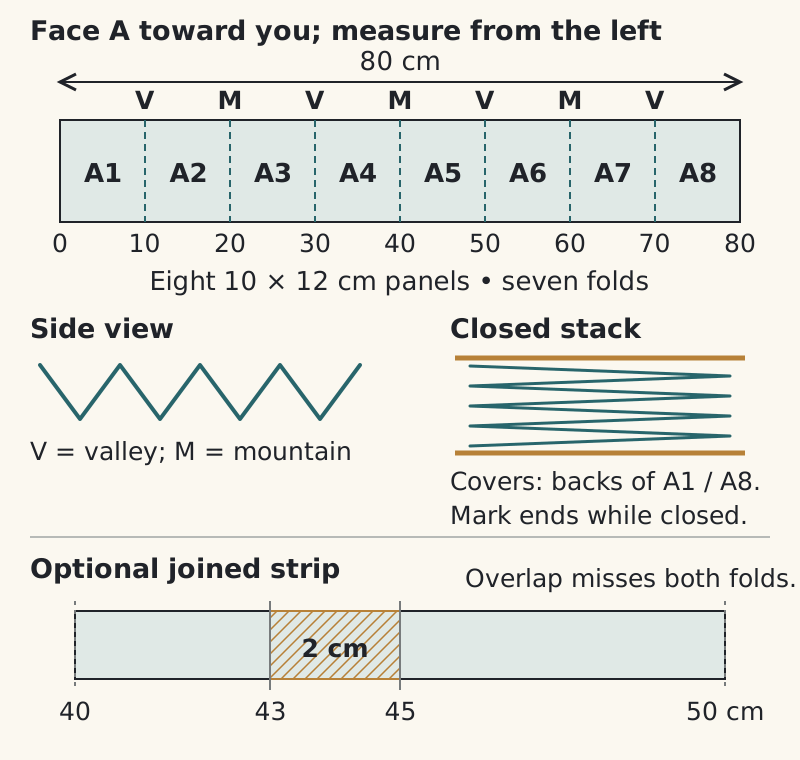
Text equivalent
An eighty-by-twelve-centimeter strip is divided into eight ten-centimeter panels A1 through A8. Seven folds at ten through seventy centimeters alternate valley and mountain relative to face A. Pleats and a closed stack show the backs of A1 and A8 as the outer cover faces. An enlarged join inset shows a two-centimeter overlap from forty-three to forty-five centimeters, between the forty and fifty centimeter folds.
Accessible alternatives
Pre-folded/pre-marked models, large-print route diagrams, high-contrast labels, tactile fold markers, audio responses, and partner assistance.
Analyze a model without constructing it; provide fictional garden content instead of personal history.
Use text and patterns as well as color; do not rely on red/green or reading speed.
Offer equivalent no-contact roles and privately planned allergy, sensory, motor, and vision accommodations.
Troubleshooting
- Edges drift
- Check: reopen the recent fold, align against measured marks, and crease once. If paper becomes weak, replace it; do not trim the whole book until its panels become progressively smaller.
Action: reopen the recent fold, align against measured marks, and crease once. If paper becomes weak, replace it; do not trim the whole book until its panels become progressively smaller. - All folds face one way
- Check: reopen and reverse every other fold. A roll is not an accordion.
Action: reopen and reverse every other fold. A roll is not an accordion. - A cover prevents opening
- Check: Check whether adhesive attaches the free 3 mm board overhang to the adjacent panel or bridges the crease.
Action: Stop and use a spare model or teacher-assisted correction; do not pull the board through the paper. - Joined seam peels
- Check: remove loose excess glue, reattach the classroom seam, and dry longer. Record it as a model limitation.
Action: remove loose excess glue, reattach the classroom seam, and dry longer. Record it as a model limitation. - Markers show through
- Check: use coloured pencil or an unpainted reverse. Do not imply historic makers faced the same problem with different materials.
Action: use coloured pencil or an unpainted reverse. Do not imply historic makers faced the same problem with different materials. - Motor fatigue
- Check: offer pre-folded strips and let the student lead design and analysis.
Action: offer pre-folded strips and let the student lead design and analysis.
Record and assess
Award two points each for an accurately described structure; a clear modern title and colophon; an observed benefit and limitation; a source-supported comparison with one historical book; and a precise statement of what your model cannot establish. Construction assistance does not reduce analytical credit. Submit an uneven or repaired model with its record rather than claiming it worked perfectly.
Which statements come from manipulating your model, and which come from a historical source?
Rubric · 10 points
- Working or accurately described structure · 2 points
- Modern labeling and colophon · 2 points
- Observed benefit and limitation · 2 points
- Sourced historical comparison · 2 points
- Explicit model limit · 2 points
Assess evidence, documentation, safety, historical specificity, and acknowledged limits; do not grade cultural imitation, beauty, speed, or physical strength as historical understanding.
Predictions to test
These are expected possibilities, never reported trial results. Record what actually happens, including failure.
A carefully folded model may close as eight connected panels with seven folds; discrepancies should be recorded.
Opening changes which cards can be seen together. It does not reveal every front and back simultaneously.
Optional covers hide two of sixteen faces, leaving fourteen accessible paper faces.
Optional extensions
- Ready-to-use fictional sequence
A1: “A School Garden: A Fictional Record.” A2: the class proposes a garden. A3: pupils measure the available space. A4: the group chooses plants. A5: volunteers prepare beds. A6: the weather delays planting. A7: planting occurs on a new date. A8: maker/date/materials, sources for structural comparison, and “Our icons and story are modern inventions.”
Do not assign actual names or make up a historical Indigenous community's practices. The fiction tests information arrangement without asking students to impersonate another people's record.
- Joined-strip alternative
Join a 45 × 12 cm strip and a 37 × 12 cm strip with 2 cm overlap, producing 80 cm total. Put the overlap at positions 43–45 cm, away from 40 and 50 cm folds. Apply a thin even approved glue layer within overlap, align long edges, press through scrap, and dry per product instructions. Mark the seam as a modern classroom join.
Sources and access limits
Source access labels below are retained from the commissioned research. Partial, indexed, abstract and catalogue access do not imply a full-text reading. No new source reading or classroom trial is claimed by this website addition.
The printed reference list retains access labels and linked titles. Full source access notes remain on this lab’s web page.
Getty Art & Architecture Thesaurus. “Screenfolds (manuscript books).”
Getty Art & Architecture Thesaurus. “Screenfolds (manuscript books).” https://www.getty.edu/vow/AATFullDisplay?find=&logic=¬e=&page=1&subjectid=300417533 . Full short terminology entry read. Useful for structural vocabulary. Its aggregate materials description is not a recipe for every object.
Getty Research Institute. “In Tlilli In Tlapalli: Reproducing Ancient Mexican Books.”
Getty Research Institute. “In Tlilli In Tlapalli: Reproducing Ancient Mexican Books.” https://www.getty.edu/research/exhibitions_events/exhibitions/obsidian_mirror/ancient_mexican_books.html . Exhibition text read. Useful for formats and the Boturini facsimile example; retain the distinction between a historical manuscript and the displayed copy.
J. Paul Getty Museum, with INAH and BNAH. “Códice Maya de México.” 2022 exhibition.
J. Paul Getty Museum, with INAH and BNAH. “Códice Maya de México.” 2022 exhibition. https://www.getty.edu/art/exhibitions/maya_codex/ . Main text and object captions read. Strong concise object introduction. Image captions reserve rights.
British Museum. “The Tonindeye (Nuttall) Codex,” Am1902,0308.1.
British Museum. “The Tonindeye (Nuttall) Codex,” Am1902,0308.1. https://www.britishmuseum.org/collection/object/E_Am1902-0308-1 . Object record read. Keep leaf counts distinct from an edition's numbered painted pages.
- SF-S09 · Source link ↗
Link check, 18 October 2026: HTTP 403. Original citation retained; source access was not re-established.
- SF-S09 · Source link ↗
Library of Congress. “Care, Handling and Storage of Asian Style Bindings.”
Library of Congress. “Care, Handling and Storage of Asian Style Bindings.” https://loc.gov/preservation/care/asianbind.html . Accordion section read. Cross-regional modern preservation advice; use only for handling logic, clearly labelled.
U.S. Consumer Product Safety Commission. “Art Materials.”
U.S. Consumer Product Safety Commission. “Art Materials.” https://www.cpsc.gov/FAQ/art-materials . Relevant safety/label discussion read. Clarifies what labelling establishes; follow local school rules and product instructions too.
American Academy of Pediatrics, HealthyChildren.org. “Choosing Safe Art & Craft Supplies for Children.”
American Academy of Pediatrics, HealthyChildren.org. “Choosing Safe Art & Craft Supplies for Children.” https://www.healthychildren.org/English/safety-prevention/at-home/Pages/Choosing-Safe-Arts-and-Craft-Supplies.aspx . Relevant selection and hygiene guidance read. General material-selection support, not certification of this dossier's untested procedures.
National Museum of the American Indian. “Essential Understandings,” Native Knowledge 360°.
National Museum of the American Indian. “Essential Understandings,” Native Knowledge 360°. https://americanindian.si.edu/nk360/about/essential-understandings . Framework read. Broad educational grounding; it does not authorize reuse of a particular community's sacred knowledge.
- SF-S26 · Source link ↗
Link check, 18 October 2026: HTTP 403. Original citation retained; source access was not re-established.
- SF-S26 · Source link ↗
Getty Education. “Picturing a Story: Photo Essay about a Community, Event or Issue.”
Getty Education. “Picturing a Story: Photo Essay about a Community, Event or Issue.” https://www.getty.edu/education/for_teachers/curricula/dorothea_lange/lange_lesson08.html . Accordion directions and assessment read. Published modern bookmaking precedent; this dossier provides a substantially different measured research-model activity.
J. Paul Getty Museum. “Códice Maya de México: Gallery Text.” 2022.
J. Paul Getty Museum. “Códice Maya de México: Gallery Text.” 2022. https://www.getty.edu/art/exhibitions/maya_codex/downloads/maya_codex_gallery_text.pdf . Relevant English/Spanish text read, especially PDF page 7 on reading. This dossier relies on the exhibition's reconstruction, not independent decipherment.
British Museum. “Untangling Maya Glyphs.” Google Arts & Culture.
British Museum. “Untangling Maya Glyphs.” Google Arts & Culture. https://artsandculture.google.com/story/untangling-maya-glyphs-the-british-museum/9AVhlqaqtBwwIw?hl=en . Institutional exposition read. Useful for word/syllable distinction; not a current comprehensive sign list.
SLUB Dresden. “The Dresden Maya Codex: Content.”
SLUB Dresden. “The Dresden Maya Codex: Content.” https://www.slub-dresden.de/en/explore/manuscripts/the-dresden-maya-codex/content . Substantive content section read. Useful for section/page identification and relation between almanacs and astronomy. Avoid extending particular deity interpretations or calendrical conversions beyond the cited account.
Metropolitan Museum of Art. “Cylindrical Vessel,” 1983.543.3.
Metropolitan Museum of Art. “Cylindrical Vessel,” 1983.543.3. https://www.metmuseum.org/art/collection/search/314311 . Object record read. Useful for comparing media without treating ceramic style as a surviving paper manuscript.
- SF-S07 · Source link ↗
Link check, 18 October 2026: HTTP 429. Original citation retained; source access was not re-established.
- SF-S07 · Source link ↗
James Doyle. “Creation Narratives on Ancient Maya Codex-Style Ceramics.” Metropolitan Museum Journal 51 (2016).
James Doyle. “Creation Narratives on Ancient Maya Codex-Style Ceramics.” Metropolitan Museum Journal 51 (2016). https://resources.metmuseum.org/resources/metpublications/pdf/Doyle_Metropolitan_Museum_Journal_v_51_2016.pdf . Relevant opening discussion of Maya books and scribal depictions read. Some dating and authenticity discussion predates the later institutional consensus about Códice Maya de México; do not repeat its old dispute status as current.
John M. D. Pohl. “Ancient Books: Mixtec Group Codices.” FAMSI.
John M. D. Pohl. “Ancient Books: Mixtec Group Codices.” FAMSI. https://www.famsi.org/research/pohl/jpcodices/pohlmixtec1.html . Complete essay read; retain attribution. Avoid its dated demographic generalizations.
John Monaghan. “Performance and the Structure of the Mixtec Codices.” Ancient Mesoamerica 1(1), 1990: 133–140.
John Monaghan. “Performance and the Structure of the Mixtec Codices.” Ancient Mesoamerica 1(1), 1990: 133–140. https://doi.org/10.1017/S0956536100000146 . Publisher abstract and bibliographic record read, not full article. Its explicit premise and argument are reported as such.
SDCELAR. “Mixtec Codices and the Living Heritage of the Ñuu Savi.” 27 September 2023.
SDCELAR. “Mixtec Codices and the Living Heritage of the Ñuu Savi.” 27 September 2023. https://www.sdcelarbritishmuseum.org/news/watch-the-talk-mixtec-codices-and-the-living-heritage-of-the-nuu-savi/ . Full short institutional report read; linked talk not watched. Names community scholars and educational projects; not a substitute for their full work.
INAH. “Códices,” catalogue entry for Códice Boturini.
INAH. “Códices,” catalogue entry for Códice Boturini. https://codices.inah.gob.mx/pc/ . Relevant catalogue entry verified. Useful for approximate date, support, and format; not grounds for treating every production question as closed.
INAH, Códice Boturini project. “Descripción del Códice.”
INAH, Códice Boturini project. “Descripción del Códice.” https://www.codiceboturini.inah.gob.mx/approaches_text.php?textID=0 . Description and relevant interpretation sections read. Use with the catalogue; distinguish observations from hypotheses. Avoid importing old catalogue “maguey” labels as analytical identification.
Digital Florentine Codex. Book 10, folio 18v. Getty Research Institute, 2023.
Digital Florentine Codex. Book 10, folio 18v. Getty Research Institute, 2023. https://florentinecodex.getty.edu/en/book/10/folio/18v . Nahuatl transcription and attributed Anderson–Dibble English translation read. A primary historical description accessed through an edited translation, not an unmediated voice.
- SF-S15 · Source link ↗
Link check, 18 October 2026: connection unavailable. Original citation retained; source access was not re-established.
- SF-S15 · Source link ↗
Kim N. Richter, Alicia Maria Houtrouw, Joshua Fitzgerald. “Competing Narratives on the Conquest of Mexico and the Fall of the Aztec Empire.” Getty, 2020, updated 2023.
Kim N. Richter, Alicia Maria Houtrouw, Joshua Fitzgerald. “Competing Narratives on the Conquest of Mexico and the Fall of the Aztec Empire.” Getty, 2020, updated 2023. https://www.getty.edu/news/competing-narratives-about-the-conquest-of-mexico-and-the-fall-of-the-aztec-empire/ . Article read. Good for named collaborators, parallel columns, and differentiated audiences.
Tana Elizabeth Villafana, Mary Elizabeth Haude, Amanda Satorius. “An analytical study of the Huexotzinco Codex using X-ray fluorescence, fiber optic reflectance spectroscopy, and portable Fourier-transform infrared spectroscopy.” Heritage Science 9, 54 (2021).
Tana Elizabeth Villafana, Mary Elizabeth Haude, Amanda Satorius. “An analytical study of the Huexotzinco Codex using X-ray fluorescence, fiber optic reflectance spectroscopy, and portable Fourier-transform infrared spectroscopy.” Heritage Science 9, 54 (2021). https://www.nature.com/articles/s40494-021-00524-1 . Relevant methods/results/discussion read. Preserve analytical and historical uncertainty.
Sylvia Rodgers Albro and Thomas C. Albro II. “The Examination and Conservation Treatment of the Library of Congress Harkness 1531 Huejotzingo Codex.” JAIC 29(2), 1990: 97–115, section 4.1.
Sylvia Rodgers Albro and Thomas C. Albro II. “The Examination and Conservation Treatment of the Library of Congress Harkness 1531 Huejotzingo Codex.” JAIC 29(2), 1990: 97–115, section 4.1. https://cool.culturalheritage.org/jaic/articles/jaic29-02-001_4.html . Linked section read. Do not repeat its erroneous classification of agave as a cactus.
Erik Velásquez García. “Silabogramas nahuas en tiempos de la Conquista.” Estudios de Cultura Náhuatl.
Erik Velásquez García. “Silabogramas nahuas en tiempos de la Conquista.” Estudios de Cultura Náhuatl. https://nahuatl.historicas.unam.mx/index.php/ecn/article/view/77886 . Abstract and publisher record read. Supports acknowledging active research on early syllabic signs, not an unqualified claim about all signs or workshops.
- SF-S19 · Source link ↗
Link check, 18 October 2026: connection unavailable. Original citation retained; source access was not re-established.
- SF-S19 · Source link ↗
Mustafa Eck. “Watch: 2000 Years of Paper Making Continues.” Getty, 1 November 2022.
Mustafa Eck. “Watch: 2000 Years of Paper Making Continues.” Getty, 1 November 2022. https://www.getty.edu/news/amate-codex-paper-video-aztec-maya-mexico/ . Introductory article read; video identified, not independently transcribed. Use for named present-day makers and a qualified continuity question.
Bodleian Libraries. “Non-destructive analysis of early Mesoamerican manuscripts conservation project.” Completed 2016.
Bodleian Libraries. “Non-destructive analysis of early Mesoamerican manuscripts conservation project.” Completed 2016. https://www.bodleian.ox.ac.uk/about/libraries/our-work/mesoamerican-manuscripts-conservation . Full project summary read. A modern methodological example, not a student protocol for analysing originals.
Biblioteca Nacional de Antropología e Historia. “Testimonios Pictográficos.”
Biblioteca Nacional de Antropología e Historia. “Testimonios Pictográficos.” https://bnah.inah.gob.mx/pictografico.php . Collection-care and access description read. Useful for explaining surrogates and restricted original handling; confirm current access rules before planning a visit.
Zelia Nuttall, ed. Codex Nuttall: Facsimile of an Ancient Mexican Codex. Cambridge, Mass.: Peabody Museum, Harvard University, 1902. Getty Research Institute copy, Internet Archive.
Zelia Nuttall, ed. Codex Nuttall: Facsimile of an Ancient Mexican Codex. Cambridge, Mass.: Peabody Museum, Harvard University, 1902. Getty Research Institute copy, Internet Archive. https://archive.org/details/gri_33125011146541 . Metadata, contributor, physical facsimile description, and access record verified; the whole scanned edition was not read or compared page by page. The record marks possible copyright status “NOT_IN_COPYRIGHT”; verify actual intended image reuse and all applicable rights before publication. Treat the edition as a historical reproduction, not a photograph of the original.